

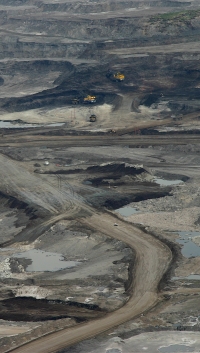

The pressure is on - the international community has called us out on the serious environmental impacts of our oil sands, but instead of cleaning up the mess both industry and government are scrambling to spin the situation clean. Problem is, calling the oil sands clean won't make it so - and amidst increasing scrutiny the international community isn't going to fall for it. read more...
Only Two Oil Sands Mines Set to Meet Tailings Rules
Tailings volume to increase to 1.1 trillion litres
A comprehensive review of regulatory documents conducted by the Pembina Institute and Water Matters found that only two of nine oil sands operations reported they would comply with a new provincial law designed to limit increases in tailings, the toxic liquid waste produced by oil sands mining operations.
The seven remaining operations submitted plans that will not comply with rules for reducing their production of liquid tailings by the first target date in 2011. Some companies submitted plans suggesting they may not meet the rules for tailings management for over 40 years.
Full Report | Backgrounder | Media Release
Oil Sands Growth Linked to Pipeline Capacity
Domestic demand for oil from the oil sands is not expected to increase significantly, but the proposed Enbridge Northern Gateway Pipeline Project would facilitate growth in oil sands production by providing an export pipeline to the British Columbia coast. If the current business-as-usual management of the oil sands prevails, the environmental impacts associated with the pipelines will be significant.
Opening the Door to Oil Sands Expansion: The Enbridge Oil Sands Pipeline highlights the climate, land, water and air impacts that would occur as a result of this project. It recommends that before further steps are taken to develop the Enbridge oil sands pipeline, the environmental management concerns of the oil sands need to be addressed and a public inquiry that could engage communities in the full range of impacts be concluded.
Fact Sheet | Media Release
Oil and Salmon Don’t Mix
A new report commissioned by the Pembina Institute has found that the proposed Enbridge Northern Gateway Pipelines pose serious risks to salmon in northern British Columbia. The project would consist of two pipelines: one to transport petroleum from the Alberta oil sands to tankers on British Columbia's coast, and the other to move petroleum condensate east from British Columbia to Alberta.
The new report, Pipelines and Salmon in Northern British Columbia: Potential Impacts, found that while construction of the pipelines will affect salmon habitat, the greatest threat comes from the potential for a pipeline leak or rupture. The Pembina Institute has called for a public inquiry to fully examine the potential impacts of the proposed Enbridge oil sands pipelines.
Full Report | Fact Sheet | Media Release
Oil Sands in Saskatchewan
Oil sands development is still in its early stages in Saskatchewan and there is an opportunity to do things properly to avoid the mistakes of Alberta.
The oil sands in Saskatchewan could hold as much as 2.3 billion barrels of bitumen, and cover an area of 27,000 square kilometres. Carbon Copy: Preventing Oil Sands Fever in Saskatchewan is a new report from the Pembina Institute, the Saskatchewan Environmental Society and the Canadian Parks and Wilderness Society. It outlines key steps that would be required to ensure any oil sands development proceeds responsibly.


